


Absurd Valuations: A Warning

In November I wrote my first article on this site, titled “Will The Economic Fallout From COVID-19 Mirror 2008?”, with the intention of bringing awareness to the potential second crumbling of financial markets and the American economy as a result of COVID-19.
Fast forward nearly a year from the March bloodbath, American equity markets have more than recovered, they’ve flourished. The real American economy as a whole however, hasn't been as fortunate. The recent euphoric state of equity markets has made investors of all sizes significant returns, and it’s not sustainable. Broader economic issues have come to fruition as a direct result of COVID restrictions, politics, and market chaos. In November I spoke about the problems that would arise as a result of federally imposed eviction bans. I highlighted the major issues that would come from allowing people to live rent free for months on end. Marketwatch.com recently published an article stating; “New York tenants may now be more than $2 billion in debt to their landlords”(1). The inevitably brutal result from landlords being in serious debt to their mortgage lenders is problematic. Will they be bailed out? Probably not, and the fallout will coincide with an equity markets crash that will be proportionately worse than March. As businesses in major cities struggle with reduced capacities and curfews, there is more damage to come. Economic stimulus being stalled as lawmakers attempt to reach an agreement is hurting the American populace, and small businesses are suffering. Jobless claims for the week ending January 23rd came in at 900,000, remaining at historic levels despite falling from a staggering 6.8 million in March (2). Even though GDP appears to be recovering, and the Fed pledging to keep interest rates at significant lows, CPI levels are increasing across the board. National debt hit $23 Trillion and counting, and China is on track to overtake the U.S. as the world's largest economy in the coming years. Despite these hindrances equity markets have been on a tear since March, with the Dow Jones Industrial Average reaching 31,000, rebounding from its March low of 18,000. The major problem with this tremendous equity recovery is unjustifiable valuations. Tesla for example (NASDAQ:TSLA) was up 743% in 2020 even as they struggled to meet delivery expectations, revealing their net profit doesn’t actually come from selling cars and therefore exposing their flawed carbon credit future revenue model. Tesla is now valued higher than the next top 10 automakers in the world combined, despite producing a fraction of its competitors. Elon Musk even tweeted about it, claiming his own company was overvalued. Tesla is not the only one, the tech-heavy NASDAQ and the small-cap Russell 2000 rose 45% and 30% last year respectively. So, how do we analyze these absurd valuations? The S&P 500 Shiller PE ratio has been a trusted source of predicting when markets are in for troubled times, recognizing that companies have become tremendously overvalued and are due for correction. Currently sitting at a 33.82 (3) (2020 growth rate ~8%), we are higher than the prelude to every major market crash except for 2000, and I predict it will all come tumbling down by mid-March of this year. I implore you to check out the Shiller chart below, you’ll be shopping for inverse market ETFs, VIX ETFs, and puts ASAP. As the Dow already begins to show signs of weakness, coupled with the Gamestop madness, there are many warning signs of a massive bubble primed for impending implosion.
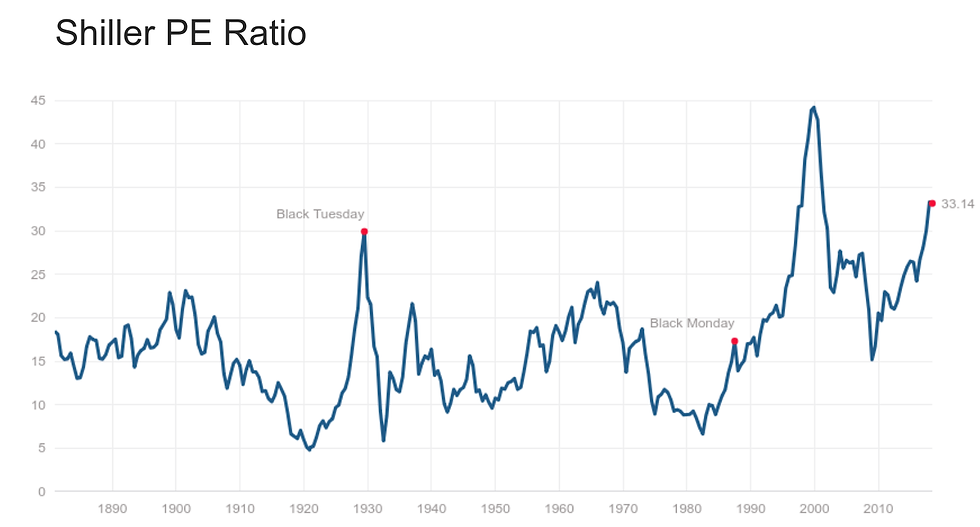
(3)
Sources


Comments